INVESTORLINE SELF-DIRECTED
INVESTORLINE SELF-DIRECTED
Led the transformation of the self-directed investing account opening experience for BMO InvestorLine. The initiative focused on replacing a legacy online account opening platform with a modern, customer-facing digital onboarding experience that enabled prospects to independently open investment accounts online. The project supported BMO's broader digital transformation strategy by reducing operational dependencies, increasing self-service adoption, and enabling straight-through processing.

BUSINESS CHALLENGE
BUSINESS CHALLENGE
InvestorLine relied on a legacy Online Application Form (OLAF) system that was originally designed for branch staff to open accounts on behalf of clients. The experience contained lengthy forms, confusing workflows, and significant manual intervention from Operations teams to review and approve applications. As a result:
Application completion rates were low.
The process created friction for prospective investors.
Branch and Contact Centre resources were required to support account opening.
Manual reviews increased operational costs and approval times.
The onboarding experience lagged behind digital competitors in the investing industry.
The business objective was to create a fully digital self-service experience that would allow prospects to open accounts independently in less than 10 minutes.
InvestorLine relied on a legacy Online Application Form (OLAF) system that was originally designed for branch staff to open accounts on behalf of clients. The experience contained lengthy forms, confusing workflows, and significant manual intervention from Operations teams to review and approve applications. As a result:
Application completion rates were low.
The process created friction for prospective investors.
Branch and Contact Centre resources were required to support account opening.
Manual reviews increased operational costs and approval times.
The onboarding experience lagged behind digital competitors in the investing industry.
The business objective was to create a fully digital self-service experience that would allow prospects to open accounts independently in less than 10 minutes.
BUSINESS CHALLENGE
InvestorLine relied on a legacy Online Application Form (OLAF) system that was originally designed for branch staff to open accounts on behalf of clients. The experience contained lengthy forms, confusing workflows, and significant manual intervention from Operations teams to review and approve applications. As a result:
Application completion rates were low.
The process created friction for prospective investors.
Branch and Contact Centre resources were required to support account opening.
Manual reviews increased operational costs and approval times.
The onboarding experience lagged behind digital competitors in the investing industry.
The business objective was to create a fully digital self-service experience that would allow prospects to open accounts independently in less than 10 minutes.
USER RESEARCH & INSIGHTS
USER RESEARCH & INSIGHTS
Research activities included competitive analysis, stakeholder interviews, and continuous usability testing.
Key findings included:
Competitor platforms offered significantly simpler onboarding experiences.
Prospective investors were overwhelmed by lengthy forms and financial jargon.
Users expected application experiences similar to modern fintech platforms.
Many applicants abandoned the process when asked for information they perceived as repetitive.
Manual approval delays negatively impacted customer satisfaction and conversion.
Research revealed the need for a progressive, guided experience that simplified complex regulatory requirements while maintaining compliance.
Research activities included competitive analysis, stakeholder interviews, and continuous usability testing.
Key findings included:
Competitor platforms offered significantly simpler onboarding experiences.
Prospective investors were overwhelmed by lengthy forms and financial jargon.
Users expected application experiences similar to modern fintech platforms.
Many applicants abandoned the process when asked for information they perceived as repetitive.
Manual approval delays negatively impacted customer satisfaction and conversion.
Research revealed the need for a progressive, guided experience that simplified complex regulatory requirements while maintaining compliance.
USER RESEARCH & INSIGHTS
Research activities included competitive analysis, stakeholder interviews, and continuous usability testing.
Key findings included:
Competitor platforms offered significantly simpler onboarding experiences.
Prospective investors were overwhelmed by lengthy forms and financial jargon.
Users expected application experiences similar to modern fintech platforms.
Many applicants abandoned the process when asked for information they perceived as repetitive.
Manual approval delays negatively impacted customer satisfaction and conversion.
Research revealed the need for a progressive, guided experience that simplified complex regulatory requirements while maintaining compliance.
STRATEGY & DESIGN RATIONALE
STRATEGY & DESIGN RATIONALE
The strategy focused on creating a customer-first onboarding experience that balanced simplicity with regulatory requirements.
Design principles included:
Minimize cognitive load through progressive disclosure.
Break complex forms into manageable steps.
Pre-populate information whenever possible.
Provide contextual guidance throughout the application.
Design for mobile-first responsiveness.
Support straight-through processing by collecting cleaner, more accurate information upfront.
Reduce dependency on branch and contact centre support.
The overall goal was to create a fast, intuitive experience that inspired confidence while reducing operational costs.
The strategy focused on creating a customer-first onboarding experience that balanced simplicity with regulatory requirements.
Design principles included:
Minimize cognitive load through progressive disclosure.
Break complex forms into manageable steps.
Pre-populate information whenever possible.
Provide contextual guidance throughout the application.
Design for mobile-first responsiveness.
Support straight-through processing by collecting cleaner, more accurate information upfront.
Reduce dependency on branch and contact centre support.
The overall goal was to create a fast, intuitive experience that inspired confidence while reducing operational costs.
STRATEGY & DESIGN RATIONALE
The strategy focused on creating a customer-first onboarding experience that balanced simplicity with regulatory requirements.
Design principles included:
Minimize cognitive load through progressive disclosure.
Break complex forms into manageable steps.
Pre-populate information whenever possible.
Provide contextual guidance throughout the application.
Design for mobile-first responsiveness.
Support straight-through processing by collecting cleaner, more accurate information upfront.
Reduce dependency on branch and contact centre support.
The overall goal was to create a fast, intuitive experience that inspired confidence while reducing operational costs.
PROCESS & ITERATION
PROCESS & ITERATION
The project followed an Agile delivery model that supported continuous improvement.
Key activities included:
Conducted competitive reviews of major banks, brokerage firms, and emerging fintech platforms.
Facilitated requirements-gathering sessions with business, product, operations, technology, legal, compliance, and audit teams.
Created customer journeys, service blueprints, wireframes, and interactive prototypes.
Established Agile delivery teams with sprint cycles focused on feature releases and optimization.
Conducted ongoing unmoderated user testing to validate design decisions and identify friction points.
Implemented bi-weekly production releases, enabling rapid iteration based on customer behavior and performance analytics.
Continuously refined workflows based on customer feedback and business priorities.
The project followed an Agile delivery model that supported continuous improvement.
Key activities included:
Conducted competitive reviews of major banks, brokerage firms, and emerging fintech platforms.
Facilitated requirements-gathering sessions with business, product, operations, technology, legal, compliance, and audit teams.
Created customer journeys, service blueprints, wireframes, and interactive prototypes.
Established Agile delivery teams with sprint cycles focused on feature releases and optimization.
Conducted ongoing unmoderated user testing to validate design decisions and identify friction points.
Implemented bi-weekly production releases, enabling rapid iteration based on customer behavior and performance analytics.
Continuously refined workflows based on customer feedback and business priorities.
PROCESS & ITERATION
The project followed an Agile delivery model that supported continuous improvement.
Key activities included:
Conducted competitive reviews of major banks, brokerage firms, and emerging fintech platforms.
Facilitated requirements-gathering sessions with business, product, operations, technology, legal, compliance, and audit teams.
Created customer journeys, service blueprints, wireframes, and interactive prototypes.
Established Agile delivery teams with sprint cycles focused on feature releases and optimization.
Conducted ongoing unmoderated user testing to validate design decisions and identify friction points.
Implemented bi-weekly production releases, enabling rapid iteration based on customer behavior and performance analytics.
Continuously refined workflows based on customer feedback and business priorities.
COLLABORATION & LEADERSHIP
COLLABORATION & LEADERSHIP
Acted as UX lead across multiple cross-functional teams, aligning business goals, technical feasibility, compliance requirements, and customer needs.
Responsibilities included:
Facilitating stakeholder workshops and design reviews.
Building alignment across product, operations, technology, legal, audit, and compliance teams.
Mentoring designers and supporting Agile delivery teams.
Presenting strategic recommendations to senior leadership.
Driving customer-centric decision-making throughout the product lifecycle.
The project required significant influence and collaboration due to the number of stakeholders involved and the complexity of financial regulations.
Acted as UX lead across multiple cross-functional teams, aligning business goals, technical feasibility, compliance requirements, and customer needs.
Responsibilities included:
Facilitating stakeholder workshops and design reviews.
Building alignment across product, operations, technology, legal, audit, and compliance teams.
Mentoring designers and supporting Agile delivery teams.
Presenting strategic recommendations to senior leadership.
Driving customer-centric decision-making throughout the product lifecycle.
The project required significant influence and collaboration due to the number of stakeholders involved and the complexity of financial regulations.
COLLABORATION & LEADERSHIP
Acted as UX lead across multiple cross-functional teams, aligning business goals, technical feasibility, compliance requirements, and customer needs.
Responsibilities included:
Facilitating stakeholder workshops and design reviews.
Building alignment across product, operations, technology, legal, audit, and compliance teams.
Mentoring designers and supporting Agile delivery teams.
Presenting strategic recommendations to senior leadership.
Driving customer-centric decision-making throughout the product lifecycle.
The project required significant influence and collaboration due to the number of stakeholders involved and the complexity of financial regulations.
CONSTRAINTS & PROBLEM SOLVING
CONSTRAINTS & PROBLEM SOLVING
Several challenges shaped the project:
Complex regulatory and compliance requirements for investment account opening.
Legacy back-end systems that constrained modernization efforts.
Multiple investment account types requiring different application paths.
Balancing customer simplicity with detailed suitability and KYC requirements.
Ensuring straight-through processing without increasing operational risk.
Integrating multiple systems including identity verification, compliance checks, and account fulfillment.
To address these challenges, the team implemented modular workflows, dynamic forms, intelligent validation, and reusable design patterns that reduced complexity while maintaining compliance.
Several challenges shaped the project:
Complex regulatory and compliance requirements for investment account opening.
Legacy back-end systems that constrained modernization efforts.
Multiple investment account types requiring different application paths.
Balancing customer simplicity with detailed suitability and KYC requirements.
Ensuring straight-through processing without increasing operational risk.
Integrating multiple systems including identity verification, compliance checks, and account fulfillment.
To address these challenges, the team implemented modular workflows, dynamic forms, intelligent validation, and reusable design patterns that reduced complexity while maintaining compliance.
CONSTRAINTS & PROBLEM SOLVING
Several challenges shaped the project:
Complex regulatory and compliance requirements for investment account opening.
Legacy back-end systems that constrained modernization efforts.
Multiple investment account types requiring different application paths.
Balancing customer simplicity with detailed suitability and KYC requirements.
Ensuring straight-through processing without increasing operational risk.
Integrating multiple systems including identity verification, compliance checks, and account fulfillment.
To address these challenges, the team implemented modular workflows, dynamic forms, intelligent validation, and reusable design patterns that reduced complexity while maintaining compliance.

FINAL SOLUTION
FINAL SOLUTION
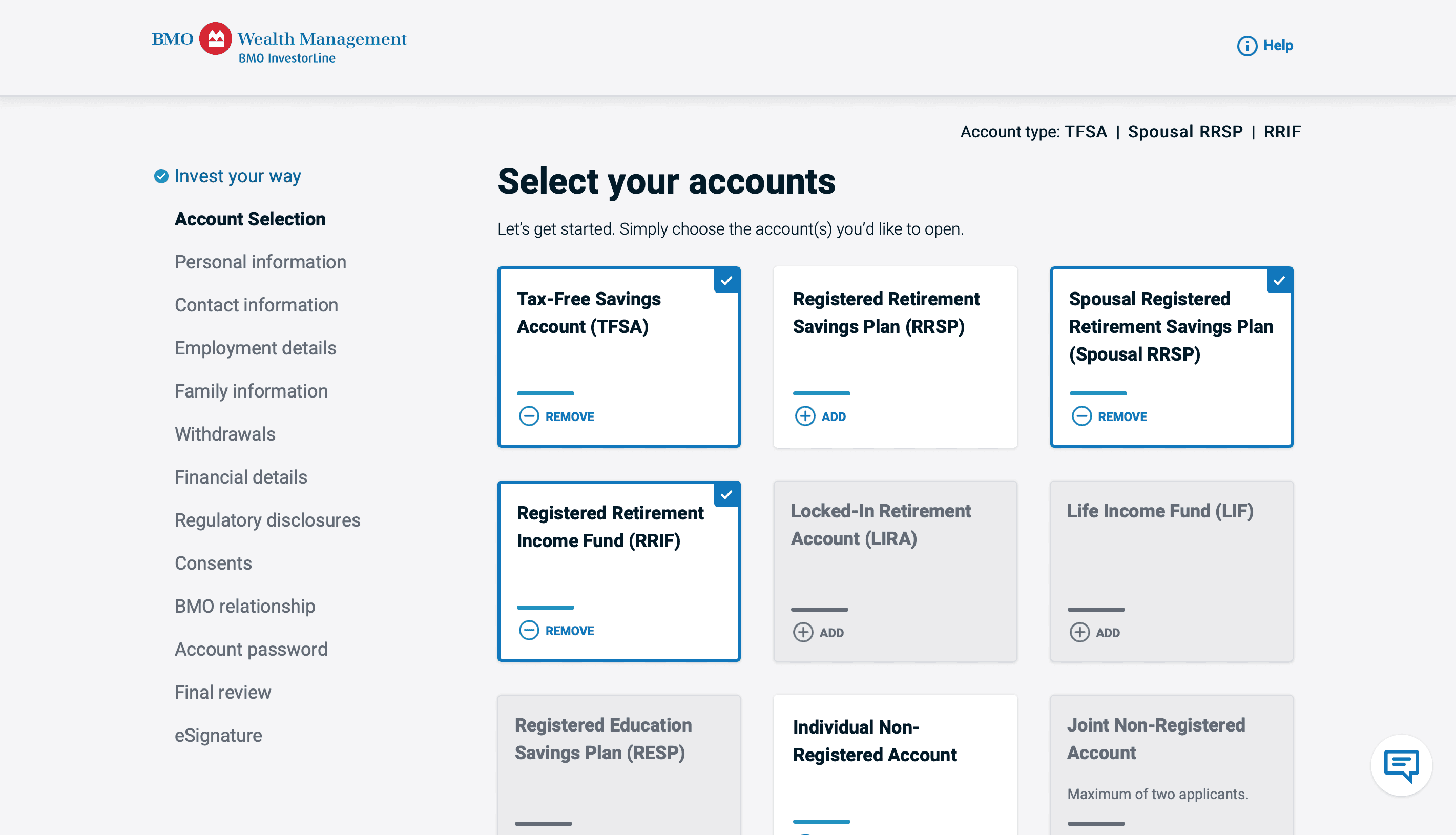
Delivered a modern digital onboarding platform that allowed prospective clients to:
Open self-directed investment accounts online without branch assistance.
Complete applications in under 10 minutes.
Navigate a simplified, step-by-step application process.
Receive faster approvals through straight-through processing.
Access the experience seamlessly across desktop, tablet, and mobile devices.
Receive clear guidance and feedback throughout the application journey.
The solution successfully transformed a complex operational process into a streamlined digital experience.
Delivered a modern digital onboarding platform that allowed prospective clients to:
Open self-directed investment accounts online without branch assistance.
Complete applications in under 10 minutes.
Navigate a simplified, step-by-step application process.
Receive faster approvals through straight-through processing.
Access the experience seamlessly across desktop, tablet, and mobile devices.
Receive clear guidance and feedback throughout the application journey.
The solution successfully transformed a complex operational process into a streamlined digital experience.
FINAL SOLUTION
Delivered a modern digital onboarding platform that allowed prospective clients to:
Open self-directed investment accounts online without branch assistance.
Complete applications in under 10 minutes.
Navigate a simplified, step-by-step application process.
Receive faster approvals through straight-through processing.
Access the experience seamlessly across desktop, tablet, and mobile devices.
Receive clear guidance and feedback throughout the application journey.
The solution successfully transformed a complex operational process into a streamlined digital experience.
OUTCOMES & METRICS
OUTCOMES & METRICS
Significant reduction in application completion time.
Increased digital self-service adoption.
Reduced dependency on branch personnel and Contact Centre support.
Improved application completion rates and conversion performance.
Increased straight-through processing rates, reducing operational workload.
Faster account approval and funding timelines.
Established a scalable onboarding framework that could support future investment products and account types.
Metrics:
Increased application completion rates from 42% to 71%, representing a 69% improvement.
Reduced average account opening time from 28 minutes to under 10 minutes, decreasing completion time by 68%.
Increased mobile application completion rates from 35% to 67%, improving mobile conversion by 91%.
Reduced application abandonment rates by 50%, from 58% to 29%.
Increased digital self-service adoption by 95%, significantly reducing reliance on branch and Contact Centre support.
Increased monthly digital account openings by 51%, from approximately 4,500 to 6,800 accounts per month.
Significant reduction in application completion time.
Increased digital self-service adoption.
Reduced dependency on branch personnel and Contact Centre support.
Improved application completion rates and conversion performance.
Increased straight-through processing rates, reducing operational workload.
Faster account approval and funding timelines.
Established a scalable onboarding framework that could support future investment products and account types.
Metrics:
Increased application completion rates from 42% to 71%, representing a 69% improvement.
Reduced average account opening time from 28 minutes to under 10 minutes, decreasing completion time by 68%.
Increased mobile application completion rates from 35% to 67%, improving mobile conversion by 91%.
Reduced application abandonment rates by 50%, from 58% to 29%.
Increased digital self-service adoption by 95%, significantly reducing reliance on branch and Contact Centre support.
Increased monthly digital account openings by 51%, from approximately 4,500 to 6,800 accounts per month.
OUTCOMES & METRICS
Significant reduction in application completion time.
Increased digital self-service adoption.
Reduced dependency on branch personnel and Contact Centre support.
Improved application completion rates and conversion performance.
Increased straight-through processing rates, reducing operational workload.
Faster account approval and funding timelines.
Established a scalable onboarding framework that could support future investment products and account types.
Metrics:
Increased application completion rates from 42% to 71%, representing a 69% improvement.
Reduced average account opening time from 28 minutes to under 10 minutes, decreasing completion time by 68%.
Increased mobile application completion rates from 35% to 67%, improving mobile conversion by 91%.
Reduced application abandonment rates by 50%, from 58% to 29%.
Increased digital self-service adoption by 95%, significantly reducing reliance on branch and Contact Centre support.
Increased monthly digital account openings by 51%, from approximately 4,500 to 6,800 accounts per month.
KEY LEARNINGS
KEY LEARNINGS
This initiative demonstrated that even highly regulated financial onboarding experiences can be dramatically simplified through thoughtful UX design and continuous iteration. The project reinforced the value of combining customer research, Agile delivery, and data-driven optimization to drive measurable business outcomes. It also highlighted the importance of designing for both customer needs and operational efficiency, ensuring that improvements in user experience directly contributed to reduced costs, increased conversions, and long-term scalability.
This initiative demonstrated that even highly regulated financial onboarding experiences can be dramatically simplified through thoughtful UX design and continuous iteration. The project reinforced the value of combining customer research, Agile delivery, and data-driven optimization to drive measurable business outcomes. It also highlighted the importance of designing for both customer needs and operational efficiency, ensuring that improvements in user experience directly contributed to reduced costs, increased conversions, and long-term scalability.
KEY LEARNINGS
This initiative demonstrated that even highly regulated financial onboarding experiences can be dramatically simplified through thoughtful UX design and continuous iteration. The project reinforced the value of combining customer research, Agile delivery, and data-driven optimization to drive measurable business outcomes. It also highlighted the importance of designing for both customer needs and operational efficiency, ensuring that improvements in user experience directly contributed to reduced costs, increased conversions, and long-term scalability.
©2026 CARLOS RUBIO DESIGN
GO BACK TO TOP
©2026 CARLOS RUBIO DESIGN
GO BACK TO TOP